All those questions you meant to ask and forgot…
The questions and answers below are a compilation of our own and those posted by Julia Runk Jones at Sengei Rhodesian Ridgebacks. We hope that our answers give you an idea of our philosophies about dogs and puppies.
How experienced are you? We have owned many dogs over 20 some years and have spent alot of time working in the obedience ring and on the hiking trail with our dogs. We are not new to raising and training puppies, but our very first litter was in 2019 with support and mentoring from Sengei Rhodesian Ridgebacks. We are expecting a new litter in October 2022.
Do you show your dogs? Yes. Both of our breeding Ridgebacks are show quality, finished AKC champions in the confirmation ring with appropriate health screens to determine their suitability for breeding. For confirmation work, we send our dogs out with handler, Kim Carpenter. We have competed in obedience trials, but took a break while our children were growing. We continue to train at Capital Dog Training Club weekly and look forward to returning to competition in the future. Ginger is currently showing and won her first major in early summer 2022.
I see Great Danes on your site. Do you breed those too? No. Both of our Danes are pet quality canines and will never be bred. We rescued Ivy and actively looked for a Dane boy (Morpheus) to join us. The Danes participate in weekly obedience work at CDTC with us. They are hilarious companions.
Do you genetically screen your dogs? Yes. We follow the guidelines of the OFA (Orthopedic Foundation for Animals) and the national breed club (Rhodesian Ridgeback Club of America). Our ridgebacks both have OFA-assigned CHIC numbers, indicating that they have passed breed-specific requirements for screening. You can look up their CHIC numbers at the OFA website.
Will the puppies be vaccinated and wormed? Yes. We give basic puppy shots at 8 weeks. Parvo is given as a separate shot to put less strain on the immune system. Dewclaws are removed on the 3rd or 4th day. The pups are wormed at weeks 3, 5 and 7 with pyrantel pamoate. After they are old enough to go outside, they begin to get puppy-safe flea and tick preventatives if the weather is warm. All pups will receive a vet examination at least once after birth and prior to leaving for their new homes.
After whelping, will your puppies move outdoors? No. The pups will be whelped in one of our bedrooms so they can be monitored 24/7 for the first several days. Bedding will be changed daily so that the puppies will develop the habit of a clean “den.” As they grow into the second week, bedding is changed twice daily. Each puppy will be handled every day, using a modern modification of the Bio Sensor method of early neurological training. Their nails will be trimmed routinely and they will get plenty of cuddling. Once their eyes are open, the bedding area will be rolled back to half the box and papers laid down in the other half. The puppies begin to wobble down to the paper without any prompting because they are used to having clean bedding. At the end of their second week, they will begin to receive supplements of goats milk, yogurt, oatmeal and eggs, gradually shifting to kibble similar to what the adults eat. The whelping box will be converted into a bed for mom and pups and moved to a room with more space and more sunlight. Our tile floor will be covered with wood shavings for elimination. The chips area is gradually pushed back away from their sleeping area to make a wider and wider clean area for play and new toys. The pups learn basic “house-keeping” and their shavings for soiling are moved closer and closer to an exterior door of the house. After three weeks, on good weather days, the puppies will have supervised exploration time outdoors.
Can I visit the puppies while I wait for mine? Prospective owners can come visit the pups after the second week. Because their immune systems are still developing, we have the following hygiene guidelines for visitors: no shoes allowed in the house. If you have dogs at home, we ask that you not come until the fifth week. For dog owners, please bathe before coming and wear clean clothes that have not been around your dogs. Stay as long as you like to handle the pups and get to know them.
What do you feed your dogs? We feed a BARF diet of 70% muscle meat, 15% bone, 10% organs and 5% fruits and veggies. Each adult dog receives roughly 1-2% of their body weight in BARF each day with 2-3 meals per week replaced with raw chicken frames to clean their teeth. We also reduce the BARF a bit and introduce kibble from time to time. We supplement with Nupro, a good probiotic, fish oil and some vitamins as appropriate for each individual dog. For our puppies, we have typically chosen not to start them on BARF until they are 6 mos of age, and then we introduce raw slowly. If you would like to learn more about raw, you might start with Balance IT by Davis Veterinary Consulting. There are also many pre-packaged raw diets available for dogs on the market now.
Are your dogs kept in kennels or runs? No. Ridgebacks are companion animals and do not thrive separated from their family. We currently have two Ridgebacks and two Danes and they share the house with us and are allowed on designated furniture. Outside, they have approximately 1 acre to run around on. They are all crate trained so that we can separate them when necessary (e.g. during heat cycles) and so that the younger ones don’t destroy the house when we are away. For anyone new to crate training, we can walk you through the process. It is also important to plan for socializing your Ridgeback to the big, wide world by taking him on trips to the pet store, park, Starbucks etc. The more situations she meets as a puppy, the more confident she will be as an adult.
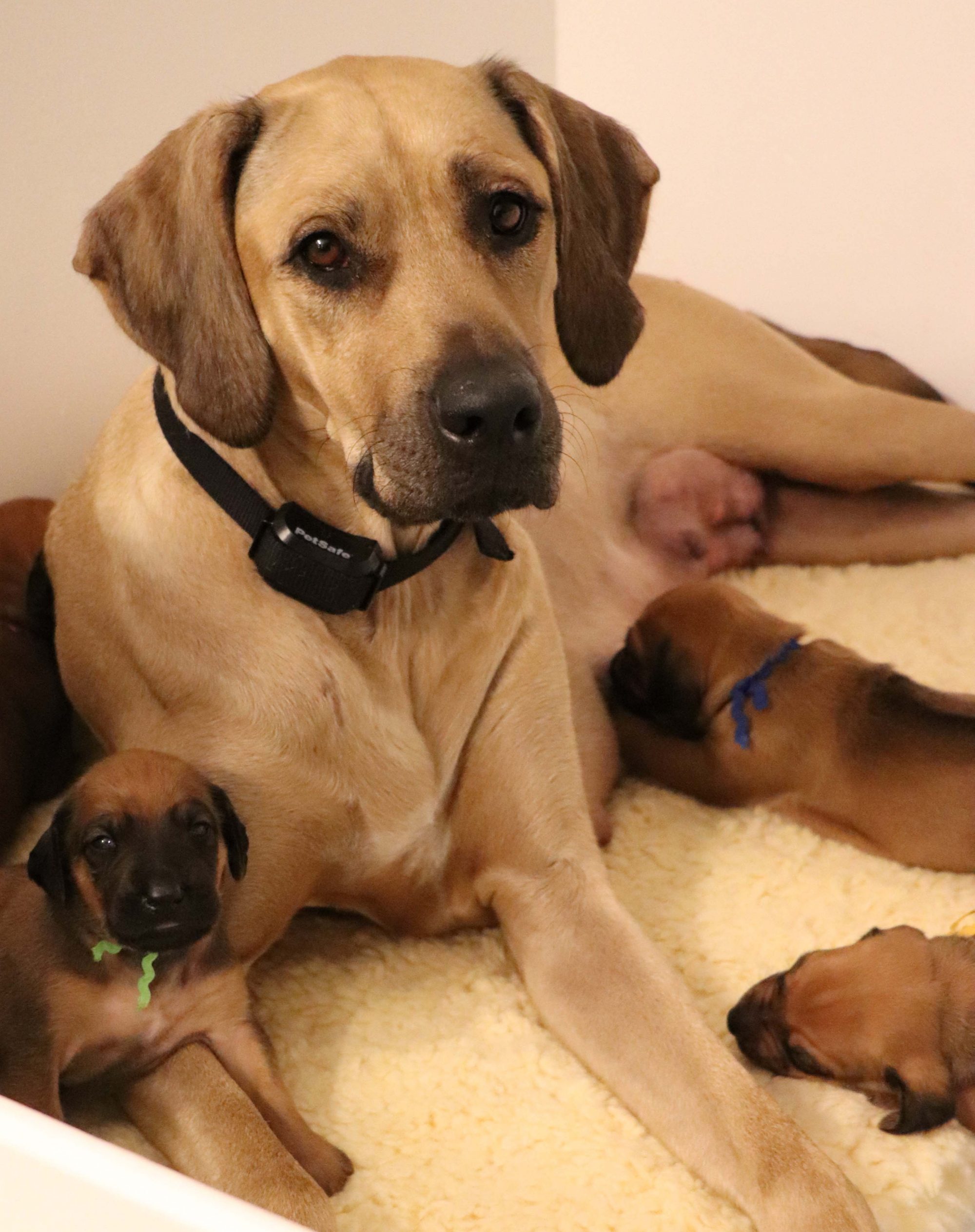
How do you tell one pup from another? We will put a color-coded rickrack collar on each pup at birth and record the color with their birth information. We will continue to keep records on each pup: weight, activity level, variations in response to stimuli. As their personalities emerge, we will keep notes regarding each pup and a photo record of their time with us. Photos will be shared with prospective families.
How much do your dogs cost? Our basic price range is $2000 – $2700 depending upon the features of the pup for conformation (showing). You will often hear pups referred to as “pet quality” or “show quality.” This is not a statement about their health, but occasionally there are features that disqualify a pup from showing (extra whirls in the ridge, kink in the tail, etc.) Puppies that do not go to show homes will be sold on limited registration, meaning that they cannot be bred. All of our puppies are covered equally by the guarantees described above. If you are approved for a puppy, you may give us a deposit of $500 toward the full purchase price of the pup. This will guarantee a pup from this particular litter, depending upon total number of puppies, your place in line (when you gave us the deposit) and what sex puppy you prefer. We will keep notes on all pups’ personalities and habits so we can make recommendations regarding which pup might best fit with your family. We ask each prospective owner to choose 3 puppies and put them in order of preference. We expect to be able to give you one of your three and will try to favor your highest preference, if possible. If one of your choices seems to be way off the mark for your situation, we will ask that you choose an alternate for your list. If we cannot place a puppy with you, we will return your deposit.
You do not have to leave a deposit, but we cannot guarantee you a pup from the litter without it.
Can we meet your adult dogs? Of course! Please call and come over to meet them, take them for a walk or sip a soda on the back deck while they crowd you for attention. They aren’t into fetching, but they love a good game of catch and some ear rubbies.
Do you cull puppies? No. We do not cull (kill) any pup with an ailment that can be remedied by veterinary intervention. We do not destroy ridgeless pups or pups with dermoid sinus. Instead, they will be sold with a spay/neuter contract and an AKC limited registration. In the rare event of dermoid sinus, it will be removed and the pup placed for the cost of the surgery or less. Ridgeless pups will be placed at cost.
Do you offer any kind of health guarantee on your puppies?
Returns: You may return the puppy within 3 weeks for any reason and get your money back, less the $500 deposit. This guarantee is void if there is evidence the pup has been abused.
Genetic Defects: We give full money back if the dog develops hip or elbow dysplasia within 3 years of purchase. You do not have to return the dog in order to get the refund. These major genetic problems can usually be detected in the OFA screening tests, which are generally run between the ages of 2 and 3 years. We encourage everyone who has a Matrix Ridgeback to get the OFA screens at the appropriate time to ensure that they are covered under the terms of the guarantee. This guarantee also applies to dermoid sinus. However, if a DS is found, we reserve the right to have it verified by a vet of our choosing before the guarantee is honored.
Cancer: We cannot cover cancers, because there are too many environmental factors involved. Nevertheless, if your dog develops a fatal cancer within the first 3 years of life and reasonable efforts were made to treat the illness, we will replace the pup with another at cost to us.
Degenerative Myelopathy: DM is a devastating, late-onset disease similar to Lou Gehrig’s Disease in humans. Fortunately, a DNA test is available to identify carriers of the gene. Our dogs have been tested and we eliminate the risk of the disease by never breeding a carrier to another carrier.
AIHA: Autoimmune Hemolytic Anemia is not usually considered a genetic problem. It is typically idiopathic and rare in occurence, however, if your dog develops fatal AIHA within the first 3 years of life, we will replace the pup at cost to us.
Do Ridgebacks shed? Yes. We recommend a good brushing once a week, followed by running a cool, wet cloth over them to remove dander that came out with brushing. A hard rubbery curry comb or a ZoomGroom are quite effective.
What sort of training will my Ridgeback need? We are more concerned about the kind of training your Ridgeback doesn’t need. Ridgebacks do not need the “tough love” type of training endorsed by Cesar Milan. They need patient, kind hands to point the way and they desire a connection to you that is only fostered when you attend class with your puppy. We have trained our Ridgebacks on attention early and then used food-based positive reinforcement and clicker training. They can be sensitive and you definitely won’t improve your bond with alot of collar correction. In Maryland, we favor CDTC (Capital Dog Training Club) and CTA (Canine Training Association). If there are enough new owners in the immediate area, I will run a free 4 week puppy class to get you started.
Do I need a fenced yard? Highly recommended. Dogs cannot be turned outside unsupervised. If you don’t mind walking your dog everyday, it can work, but keep in mind that Ridgebacks are high energy dogs. There will be days when it is wet, snowy, cold or you feel sick and the dog will still need to go for a walk…
Can I keep a Ridgeback in the city? Many people have successfully kept their Ridgeback in the city. Just be aware that it is harder and may require some adjustment on your part. People who are successful at it usually have a dog walker or doggy daycare to help them give the pup exercise and socialization needed for healthy development. You can’t just leave him alone in the apartment all day and come home to find a sane and happy puppy. You may just find your apartment in shreds.
What should I look for in choosing a breeder? Think about what you wouldn’t want to deal with. We recommend that you not buy from a breeder if they do any of the following:
- Refuse to let you see or handle their adult dogs
- Have dogs that are shy or fearful of being touched
- Never let you see the whole litter, but instead bring out one puppy and tell you it is the one you get
- Have a contract that seriously restricts your rights to your own dog or who has very limited guarantees
- Always keep their dogs in outdoor kennels and have no house dogs at all
- Refer to a pup as “it”
- Have filthy premises, with unreasonable amounts of excrement in or around the house
- Show little interest in listening to you and your concerns
- Give references that turn out to be their relatives or work colleagues and won’t give you the name of their vet
- Have a number of litters on the ground at the same time or whose kennel consists of a large number of young bitches
- Have no concerns for your specific situation or are over-eager to ship a dog to you
- Have no older dogs (what do they do with them?)
- In general, doesn’t seem like a person you would want to know. Remember that you have to count on this person to be there for you when you have a problem with your dog.